
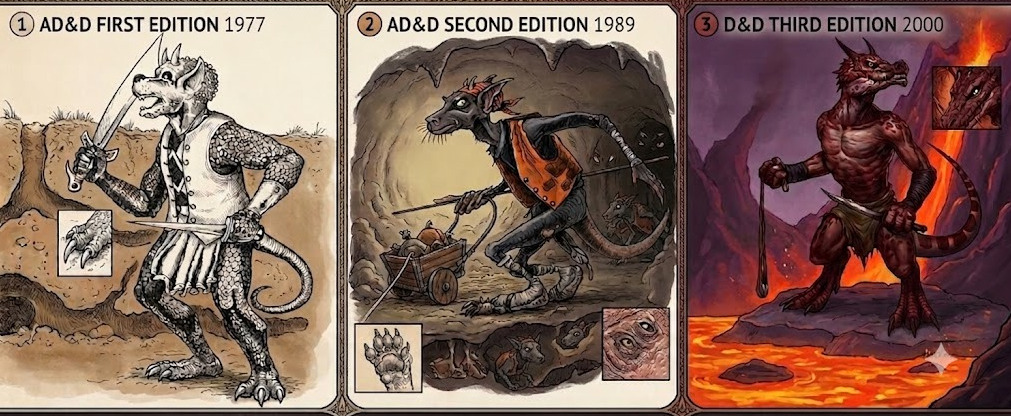
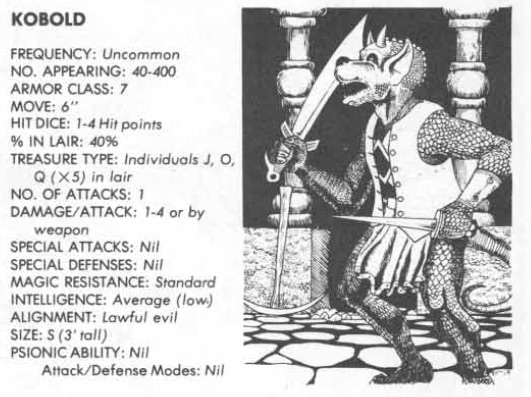
The kobold that most of us grew up with was a nasty little dog creature. Illustrated by David C. Sutherland III in 1977 for the original AD&D Monster Manual.
They barked like small dogs, smelled like damp wool and rotting wood, and were fundamentally defined by their weakness (half a Hit Die!). They were ambush monsters, using numbers to make up for their negligeable fighting threat.
Note that AD&D had a rule where Fighters got a number of attacks equal to their level when fighting creatures less than 1 Hit Die
The second edition of AD&D came out in 1989 and retconned them into more rat-like vermin (art by Tony DiTerlizzi). They still had a dog-like head and little horns, but they were rodents: scrawny, flea-bitten, squeaking cave-vermin. Trap-making and tunneling were the focus rather than the the sheer-number ambush.
Then in the big revamp of D&D third edition in 2000 under Wizards of the Coast, artist Todd Lockwood redesigned the kobold: he removed the canine and rodent traits and replaced them with reptilian features.
Suddenly they were baby dragons! Fourth and fifth editions doubled down: spells! fire-spitting! Draconic background and lore! There are even options to play them as PCs. Volo’s Guide to Monsters (2016) gave them a massive cultural expansion: no longer just weak pests, they're intensely communal, self-sacrificing, and incredibly hard-working tiny dragons.
A big creative shift that probably involved the whole 3E design team.
This left room in the monster ecosystem for goblins to inherit (or take full control of?) the AD&D kobold role, moved from "lesser orc" to nasty little ambushing pests.
First edition orcs had pig faces mind you, but we'll save that for another post.
Chainmail and White Box D&D
When Gary Gygax introduced kobolds into the tactical miniature Chainmail rules in 1971, they were grouped with goblins, orcs, and trolls. They had no reptilian identity yet and were probably inspired by generic, small, malicious humanoids from the fantasy fiction of the time.
In the first edition of the original Dungeons & Dragons (the "White Box" rules of 1974), kobolds were barely described. The text said they were "like goblins, but weaker" with light sensitivity.
Players had to fall back on the folklore: wicked, dwarf-like/gnome-like earth sprites who plagued dungeon delvers.
German Folklore
Kobolds were mischievous spirits from German mythology. There were house spirits like brownies and pixies, mine spirits blamed for all sorts of troubles (and the origin of the name for the element cobalt), and even ship spirits.
They were invisible, but if seen they apparently looked like a wrinkled old man the size of a toddler.
Kobolds Ate My Baby!
My love of kobolds goes way back. When I was doing game stuff with Hubris Games we were the initial publishers of Kobolds Ate My Baby.
That first version was conceived during a delightfully over-caffeinated return road trip from Origins in 1999.
Telrhin: Kerdens and Wyrmlings
So where does all this leave them in Telrhin? They mostly kept their "dogling" AD&D thing, and if anything became even more dog-like.
We swapped them out with the newer dragon-y version for the Hill East Campaign, and they were a lot of fun: bomb-tossing little fire-spitting nuisances.
I decided there was room for both after that, and now we have kerden (doglings) and draken (wyrmlings).
Adding them into the world meant a little tinkering with the balance of power at the bottom. Not just goblins ("geblings") and kobolds anymore, now there are three scrappy little nasties at the bottom of the food chain. Behold, the Lowly Triad!
The Lowly Triad: Guide to the Lesser Evils (Geblings, Kerden, and Wyrmlings)
Three races of small, malicious humanoids vying for territory, scraps, and the favor of darker powers. Outsiders often mistake them for one another, their biology and culture are very different.
Kerden hate Geblings because Geblings are untrustworthy and will betray a truce the second it suits them.
Geblings fear Wyrmlings because you can't bribe or reason with a Wyrmling hive-mind.
Wyrmlings view both as food or slave labor to feed the insatiable appetite of the Queen.
Geblings (The Burrowers)
aka Goblins, Grendmek
Small, wiry mammals with oversized ears, needle-like teeth, and nimble fingers.
Societal Trait: Conniving, hyper-individualistic, and intensely self-serving.
Habitat & Lifestyle: The Burrowers. While they live underground, Geblings despise the deep, crushing dark of solid stone caves. Instead, they prefer extensive, chaotic networks of burrows and tunnels dug into soft earth, clay, or hillsides—often right beneath the surface of civilized lands.
Behavior: Geblings don't do teamwork unless it benefits them or saves their skin. Their "society" is a loose collection of backstabbing factions. They are natural-born hoarders, thieves, and trap-makers, relying on petty sabotage and ambushes rather than open warfare.
Kerdens (The Pack)
aka Doglings (old-school Kobolds)
Canine-mammalian humanoids with short muzzles, expressive ears, and a light coat of mangy fur.
Societal Trait: Fiercely pack-oriented, loyal to the alpha, and driven by collective survival.
Habitat & Lifestyle: The Cave Dwellers. Kerden like cave systems, caverns, and abandoned mines. Their lairs are filthy, loud, and organized by hierarchy.
Behavior: What a kerden lacks in individual intellect, it makes up for in pack coordination. They hunt in tightly synchronized groups, using yaps, barks, and whines to communicate tactics in the pitch black. An isolated kerden is a cowardly, trembling creature, but a pack of twenty is a fearless, coordinated meat-grinder.
Wyrmlings (The Hive)
aka Draken (D&D 5E Kobolds)
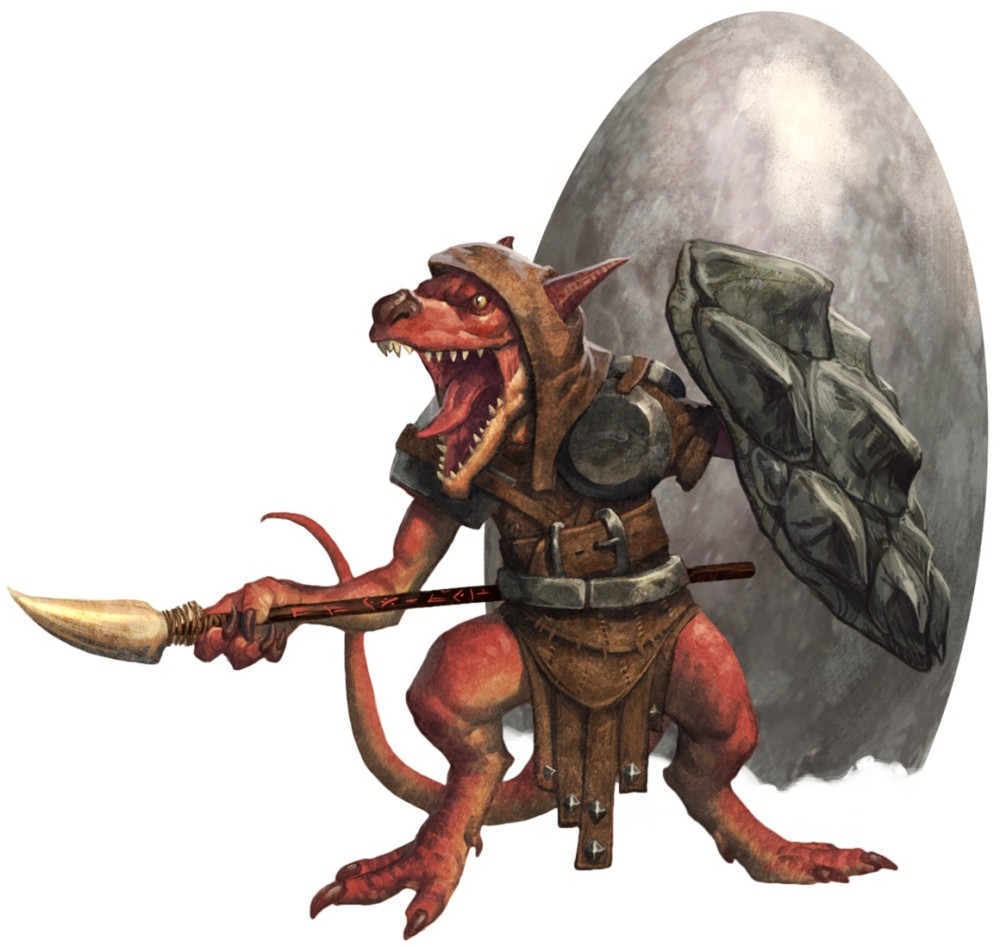
Cold-blooded, scaled reptilians with slitted eyes, and elongated snouts.
Societal Trait: Fanatical caste system centered around a queen.
Habitat & Lifestyle: The Deep Lairs. Wyrmlings dwell in the deepest, hottest thermal vents and volcanic fissures of the underworld. At the heart of their labyrinthine fortresses lies the wyrmling Queen—a massive, bloated, immobile matriarch who does nothing but consume resources and lay hundreds of eggs a day.
Behavior & Variance: Wyrmlings view themselves as true scions of dragons. The Queen's magical bloodline hatches with biological castes:
Spitters: Standard infantry capable of projecting a small stream of chemical fire from their throats.
Flyers: Leather-winged scouts and drop-troopers who ambush enemies from the cavern ceilings.
Hedge-Wizards: Rare, magically attuned wyrmlings who channel primitive elemental sorcery to defend the brood.
Dungeons & Dragons, D&D, and Advanced Dungeons & Dragons are trademarks of Wizards of the Coast LLC. Text and intellectual property regarding older editions are used for historical commentary and educational purposes. All artwork remains the property of its respective creators and copyright holders.