
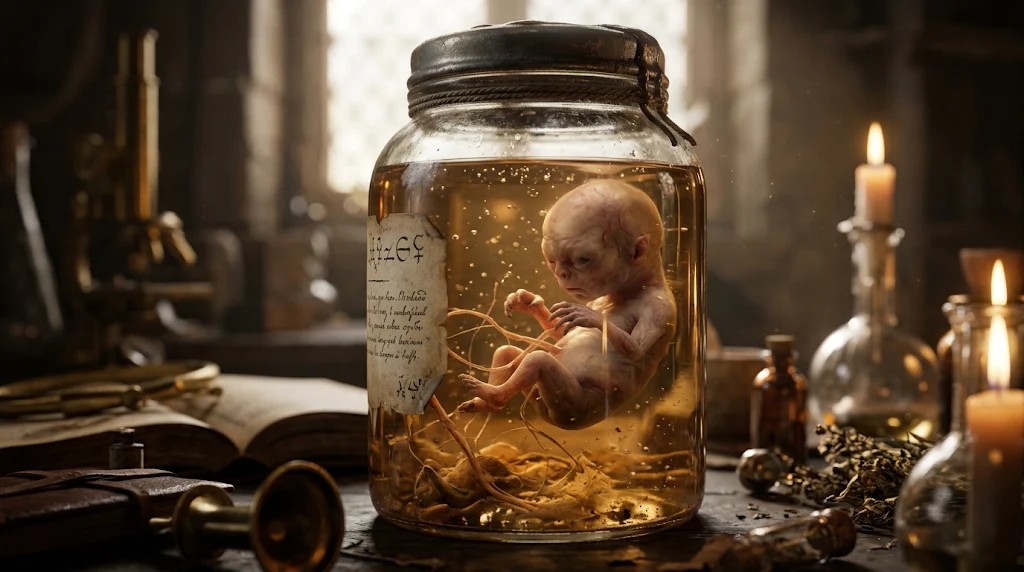
Our old AD&D campaign had a Homunculus that was exceedingly annoying for me as DM. The mage (nee "Magic-User") used it as a flying uber-familiar, and amped it up with additional spells and magic, making it invisible and almost impossible to kill. One did eventually die in a massive area-of-effect fireball, but the mage easily absorbed the 2d10 HP of psychic blow-back and just made another one the next session.
So I hated homunculi.
Over the editions D&D has treated them as little humanoid familiars, sometimes little battle-bots, and sometimes mini-golems.
In Dragonbane -- our current campaign -- the homunculus spell (Alchemy) captures it nicely, but the homunculus is still just a (slightly begrudging) variant of the D&D humanoid servant familiar.
Watching Little Prophets made me curious about folklore and homunculi and how much more interesting they could be.
In the 16th century the alchemist Paracelsus wrote about them -- and how to make them -- borrowing pieces from Jabir ibn Hayyan's 8th century Kitab al-Tajmi'. Not a little bound humanoid, but an ethereal spirit gestating in a jar that can prognosticate.
Paracelsus and the Alchemical Recipe: "Spagyric Artifice"
The most influential recipe for the homunculus comes from the 16th-century Swiss-German physician and alchemist Paracelsus in his treatise De Natura Rerum (1537):
- Incubation: Human sperm sealed inside an alchemical glass vessel (cucurbite) and buried in horse manure (a standard alchemical method for maintaining a steady heat) for forty days until it begins to putrefy and show signs of movement.
- Nourishment: Once the formless mass assumes the faint outline of a translucent human infant, it has to be fed daily on the "arcanum of human blood" and kept at the precise temperature of "a horse's womb" for forty weeks.
- Result: The creature emerges as a living child, identical to a natural human in all aspects except size. In folklore and occult tradition, homunculi were believed to possess preternatural intelligence, prophetic insight, and secrets of the spiritual realm.
Some thoughts on how it integrates into Telrhin:
- Are they invisible to the gods (as magical constructs they have no Ignis spark)?
- Do they exist outside the fates of the Ilrajir?
- Do they scream or twitch in the presence of Time Bleeds, Diegesic Storms, and Rifts? Portals to the Umbra, gates to the Embers, or approaching Ignum horrors?
- Can they "smell" residual creation sparks, invaluable tools for hunting artifacts like the Tears of Ninrandivel or even the Kibil-Haal?
- Glamour Piercing: can they sees through faie illusions, and shapechangers (vaesen, omlarcats)?
- Are they a prized hunt: their blood is saturated with pure vis and blood-arcanum, hunted by mages, guilds, or darker groups like the Tendrils or the cultists of Thar-Emykl?
- They definitely have to be kept in that jar :)
There's a hedge magic variant in German/Slavic folklore: a magically infused mandrake root. Not nearly as mystical. You dress it in little people clothes and it just sits there and "guards the household". It's also supposed to double any silver placed beside it.
Ars Magica treats it as more of a lab assistant, but it's a metaphysical dilemma: if it's forged with pure magic it can't have a soul; if you try to give it an artificial soul, you breach the limits of Hermetic magic; if you leave it empty, fairies, ghosts, or infernal demons might claim it.
I'm looking forward to the next Homunculus at our table.